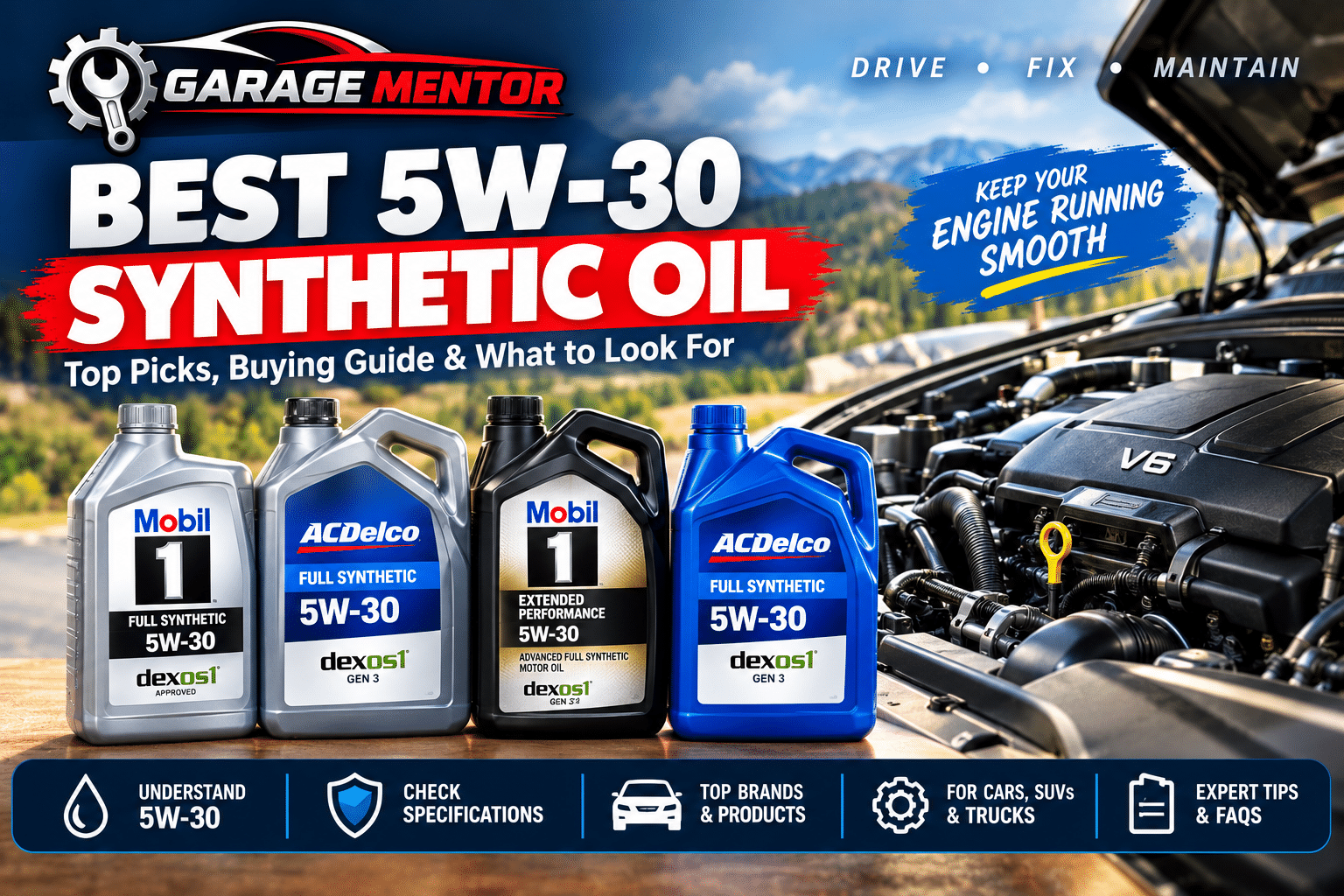
Best 5W-30 Synthetic Oil: Top Picks, Buying Guide & What to Look For
Choosing the best 5W-30 synthetic oil can be confusing. Walk into an auto-parts store or search online, and you’ll find dozens of products claiming excellent engine protection, better cleanliness, longer oil life, improved performance, or protection for high-mileage engines.
But the most expensive bottle isn’t automatically the right choice.
The right 5W-30 synthetic oil depends on your vehicle manufacturer’s requirements, engine design, operating conditions, oil specifications, and the exact approvals printed on the bottle.
For many modern gasoline vehicles, full synthetic 5W-30 is an excellent option when 5W-30 is the specified viscosity. However, you should always check your owner’s manual before buying because some engines require 0W-20, 0W-30, 5W-20, 5W-40, or another viscosity.
For GM vehicles, the dexos1 Gen 3 specification matters most. GM’s official licensed-products database currently lists numerous 5W-30 oils, including ACDelco products, under dexos1 Gen 3.
In this Garage Mentor guide, we’ll explain what 5W-30 means, how synthetic oil works, what makes one product different from another, and which types of 5W-30 oil are worth considering.
Quick Answer: What Is the Best 5W-30 Synthetic Oil?
There isn’t one 5W-30 oil that is universally best for every vehicle.
Instead, look for a full synthetic 5W-30 that meets your vehicle manufacturer’s required specifications and approvals.
Some well-known options include:
- Mobil 1 5W-30
- Mobil 1 Extended Performance 5W-30
- Mobil 1 Truck & SUV 5W-30
- Mobil 1 Advanced Clean 5W-30
- Mobil Full Synthetic 5W-30
- ACDelco Full Synthetic 5W-30
- Other licensed 5W-30 products that meet the required specification
For example, GM’s dexos database lists ACDelco Full Synthetic 5W-30 products as dexos1 Gen 3 licensed, while Mobil’s current product information lists several 5W-30 products with GM dexos1 Gen 3 licensing.
Our simple buying rule:
Don’t choose 5W-30 simply because it says “full synthetic.” Choose the 5W-30 that meets your vehicle’s required specification.


What Does 5W-30 Mean?
Before choosing the best 5W-30 synthetic oil, it helps to understand what 5W-30 actually means.
The number isn’t a brand name or performance rating.
It describes the oil’s SAE viscosity grade.
What does the “5W” mean?
The 5W portion describes the oil’s low-temperature viscosity characteristics.
The “W” stands for winter, not weight.
The lower the first number, generally speaking, the better the oil’s low-temperature flow characteristics.
What does the “30” mean?
The 30 represents the oil’s viscosity classification at operating temperature.
In simple terms:
5W-30 is designed to flow appropriately during cold starts while maintaining an SAE 30 viscosity grade at operating temperature.
Mobil similarly explains that the first number refers to cold-temperature viscosity and the second number refers to viscosity at operating temperature.
Why Choose Full Synthetic 5W-30?
Full synthetic motor oil is engineered from highly refined base oils and a carefully formulated additive package.
Compared with conventional and synthetic-blend oils, full synthetic formulations are designed to provide strong resistance to oxidation and breakdown under demanding conditions.
For example, Mobil states that its Full Synthetic 5W-30 is formulated for gasoline-powered vehicles and is designed to resist oil breakdown, help control sludge and deposits, and maintain viscosity at high operating temperatures.
However, “synthetic” shouldn’t be your only buying criterion.
A full synthetic oil can still be the wrong oil for your engine if the viscosity or required specification is incorrect.
What Makes a Good 5W-30 Synthetic Oil?
When comparing products, Garage Mentor recommends looking beyond the front label.
Check these factors:
1. SAE viscosity
Make sure your vehicle actually requires 5W-30.
2. Manufacturer approval
Some vehicles require specific manufacturer approvals.
3. API classification
Look for the API service category specified by your vehicle manufacturer.
4. ILSAC specification
Some gasoline vehicles specify an ILSAC standard.
5. GM dexos approval
For applicable GM vehicles, check for the appropriate licensed dexos specification.
6. Full synthetic formulation
If your vehicle calls for or benefits from synthetic oil, choose a genuine full synthetic product.
7. Vehicle application
Consider whether you’re driving:
- A commuter car
- SUV
- Pickup truck
- Turbocharged vehicle
- High-mileage vehicle
- Performance vehicle
- Vehicle used for towing
Best 5W-30 Synthetic Oil: Our Main Options
Rather than declaring one product the universal winner, it makes more sense to match each oil to a specific type of driver or vehicle.
1. Mobil 1 5W-30
Best for: Drivers looking for a widely available premium full synthetic 5W-30.
Mobil 1 5W-30 is an advanced full synthetic motor oil. Mobil describes it as providing protection against daily wear and harsh conditions, helping maintain engine cleanliness, and protecting against high temperatures.
The current Mobil 1 5W-30 product information also lists GM dexos1 Gen 3 licensing.
Why consider Mobil 1 5W-30?
- Full synthetic formulation
- Widely available
- Designed for gasoline engines
- Available in a common SAE viscosity
- GM dexos1 Gen 3 licensed version
- Suitable for many cars, SUVs, and light trucks where 5W-30 is specified
Important:
Don’t assume every Mobil 1 product is identical.
Mobil sells several different 5W-30 formulations.
Always check the exact bottle and product specification before buying.
2. Mobil 1 Extended Performance 5W-30
Best for: Drivers looking for a 5W-30 formulated for extended-drain applications where the vehicle manufacturer’s maintenance schedule permits it.
Mobil states that its Extended Performance line is intended for modern gasoline-powered vehicles, including turbocharged engines and light trucks. Its current 5W-30 product lists GM dexos1 Gen 3 approval.
One important point:
Longer oil-life claims don’t mean you should automatically extend your oil-change interval.
Always follow:
- Your owner’s manual
- Your vehicle’s oil-life monitoring system
- Warranty requirements
- Manufacturer maintenance recommendations
Mobil itself advises checking the owner’s manual for the recommended viscosity, API classification, and builder approval.
3. Mobil 1 Truck & SUV 5W-30
Best for: Gas-powered trucks and SUVs that specifically call for 5W-30.
Truck owners often want an oil designed around the conditions their vehicles encounter.
Mobil’s Truck & SUV 5W-30 is marketed for gas-powered trucks and SUVs and is formulated for demanding conditions including towing and hauling. Its product information lists GM dexos1 Gen 3 licensing for the 5W-30 version.
This can make it an interesting option for:
- Pickup trucks
- Full-size SUVs
- Towing vehicles
- Work vehicles
- Drivers who frequently haul loads
But again, verify that your engine requires 5W-30.
4. Mobil 1 Advanced Clean 5W-30
Best for: Drivers prioritizing an oil marketed around engine cleanliness and modern gasoline-engine requirements.
Mobil’s Advanced Clean 5W-30 is currently listed with GM dexos1 Gen 3 licensing.
The product is designed for modern gasoline applications and is another option worth comparing when your vehicle specifies 5W-30.
5. ACDelco Full Synthetic 5W-30
Best for: GM owners looking for an OEM-branded option.
ACDelco is closely associated with General Motors, and GM’s official dexos database lists multiple ACDelco Full Synthetic 5W-30 products as dexos1 Gen 3 licensed.
GM’s Chevrolet parts catalog also lists ACDelco GM Original Equipment dexos1 Gen 3 Full Synthetic 5W-30, GM Part #19432351 / ACDelco Part #10-9324. GM describes the oil as engineered and tested to GM standards and says Gen 3 is backward compatible with previous generations of dexos1, ILSAC GF-6, and API SP oils.
Why consider ACDelco?
- GM-associated brand
- Full synthetic options
- 5W-30 available
- dexos1 Gen 3 licensed products
- Designed for GM applications
ACDelco vs Mobil 1 5W-30
This is a common comparison.
Both brands have 5W-30 products carrying GM dexos1 Gen 3 licensing.
Instead of saying one brand is universally better, compare the specific product.
| Feature | ACDelco 5W-30 | Mobil 1 5W-30 |
|---|---|---|
| 5W-30 available | Yes | Yes |
| Full synthetic options | Yes | Yes |
| GM dexos1 Gen 3 licensed products | Yes | Yes |
| Gasoline applications | Yes | Yes |
| Multiple formulations | Yes | Yes |
| High-mileage versions available | Varies | Yes |
| Truck/SUV formulation | Varies | Yes |
The important takeaway is simple:
Look at the exact oil specification rather than choosing a brand solely because you recognize the name.
What is dexos1 Gen 3?
If you’re shopping for 5W-30 for a GM vehicle, you may notice dexos1 Gen 3 on the bottle.
This is a GM engine oil specification.
GM maintains an official database of licensed dexos products.
According to GM, only licensed dexos products have been certified to meet the dexos specification. GM also explains that authentic licensed products can be identified by the dexos icon and an 11-character license number on the package.
This is particularly important when buying online.
Don’t just search:
“cheap 5W-30 oil”
Instead, search for:
“5W-30 full synthetic dexos1 Gen 3”
when your vehicle requires that specification.
Why Does the dexos License Matter?
A bottle might say:
5W-30
and
Full Synthetic
but that doesn’t automatically mean it’s suitable for every GM engine.
GM specifically warns that unlicensed products have not gone through its dexos testing and approval process.
That’s why Garage Mentor recommends checking the exact product.
Before clicking “Buy Now”:
Look for:
SAE 5W-30
Full Synthetic
Required API/ILSAC specification
Required manufacturer approval
Authentic dexos license, when required
Best 5W-30 Synthetic Oil for Chevy Silverado
Because Garage Mentor focuses heavily on automotive products, this is an important application.
A number of Chevrolet Silverado engines use 5W-30, but not every Silverado engine does.
That’s critical.
For example, depending on the model year and engine, a Silverado may require 5W-30, while another engine may specify 0W-20 or a diesel-specific oil.
Therefore:
Never choose 5W-30 just because you own a Silverado.
Check the exact engine and model year first.
For a GM gasoline engine that specifically requires 5W-30 and the appropriate dexos1 specification, products such as ACDelco Full Synthetic 5W-30 and qualifying Mobil 1 5W-30 products can be options. GM’s dexos database currently lists both ACDelco and Mobil products among its licensed offerings.
Best 5W-30 Synthetic Oil for High-Mileage Cars
If your vehicle has accumulated significant mileage, you may see products marketed as:
High Mileage 5W-30
These oils are formulated specifically for older or higher-mileage engines.
However, high mileage alone doesn’t mean you must use high-mileage oil.
Consider:
- Oil consumption
- Seepage or leaks
- Engine age
- Manufacturer recommendations
- Current oil specification
- Driving conditions
If you decide to use a high-mileage formulation, make sure it still meets your vehicle’s required specifications.
Best 5W-30 Synthetic Oil for Trucks
Pickup trucks often experience more demanding operating conditions than lightly loaded passenger cars.
A truck may be used for:
- Towing
- Hauling
- Off-road driving
- Long highway trips
- Construction work
- Heavy loads
- Frequent stop-and-go driving
For this type of application, look for a 5W-30 product specifically formulated for trucks if your engine calls for 5W-30.
Mobil, for example, markets its Truck & SUV 5W-30 for gas-powered trucks and SUVs and specifically discusses towing and hauling applications.
Best 5W-30 Synthetic Oil for Turbocharged Engines
Turbocharged engines can place significant thermal demands on engine oil.
If your turbocharged gasoline engine specifies 5W-30, choose a quality oil that meets the manufacturer’s required specifications.
Don’t automatically switch viscosity simply because the engine is turbocharged.
Mobil says its 5W-30 range includes products intended for turbocharged gasoline engines, while specific products carry different approvals.
What should you look for?
- Correct viscosity
- Correct API specification
- Required manufacturer approval
- Full synthetic formulation when appropriate
- Genuine product from a reputable seller
Is 5W-30 Good for Older Engines?
It can be, if 5W-30 is the viscosity specified for the engine.
Older engines aren’t automatically better served by thicker oil.
If the manufacturer specifies 5W-30, a quality synthetic 5W-30 may be an excellent choice.
If the manufacturer specifies 10W-30 or another viscosity, don’t change it simply because you prefer synthetic 5W-30.
5W-30 vs 0W-20
This is one of the most important comparisons for modern vehicles.
5W-30
- Slightly higher operating-temperature viscosity
- Common in many older and newer engines
- Used across cars, SUVs, and trucks
- Available in many full synthetic formulations
0W-20
- Designed for lower cold-temperature viscosity characteristics
- Common in many newer engines
- Often selected by manufacturers for fuel-economy and engine-design requirements
Which is better?
Neither is universally better.
The correct viscosity for your engine is the one specified by the manufacturer.
Never switch from 0W-20 to 5W-30 simply because you believe thicker oil offers more protection.
5W-30 vs 5W-20
Both oils have the same 5W cold-temperature viscosity grade but different operating-temperature viscosity grades.
5W-30 is the higher viscosity grade at operating temperature.
5W-20 is thinner at operating temperature.
Again, don’t select between them based solely on personal preference.
Use the viscosity specified by your engine manufacturer.
5W-30 vs 10W-30
These two oils have the same “30” operating-temperature viscosity classification but differ in their low-temperature viscosity characteristics.
5W-30 is designed to have better low-temperature flow characteristics than 10W-30 under the SAE viscosity classification.
This is one reason 5W-30 is widely used in modern vehicles.
But the manufacturer’s specification remains the deciding factor.
Synthetic vs Synthetic Blend vs Conventional Oil
When shopping for engine oil, you may see three broad categories.
Full Synthetic
Designed using synthetic base oils and advanced additive systems.
Often selected for modern engines and demanding applications.
Synthetic Blend
A mixture of synthetic and conventional base oils.
Can offer a middle ground between conventional and full synthetic formulations.
Conventional
Traditional petroleum-based motor oil.
Still suitable for some applications where the manufacturer allows it.
Which should you buy?
For a modern vehicle that recommends full synthetic oil, use full synthetic.
For a vehicle that allows multiple oil types, follow the manufacturer’s recommendations.
Why Oil Additives Matter
Engine oil isn’t just base oil.
Modern motor oils contain additive packages designed to provide properties such as:
- Detergency
- Dispersancy
- Oxidation resistance
- Wear protection
- Corrosion protection
- Deposit control
- Viscosity stability
This is another reason you shouldn’t judge motor oil by viscosity alone.
Two oils can both be labeled 5W-30 while having different additive packages and approvals.
Does More Expensive 5W-30 Mean Better Oil?
Not necessarily.
Price can vary because of:
- Brand
- Formulation
- Additive package
- Marketing
- Packaging size
- Warranty
- Extended-drain claims
- Retailer pricing
The most important question is:
Does the oil meet your engine’s requirements?
If yes, then compare price, availability, and formulation.
How to Read a 5W-30 Oil Bottle
When shopping online or in a store, inspect the label.
Front of bottle
Look for:
SAE 5W-30
Full Synthetic
Manufacturer/brand
Back of bottle
Look for:
API classification
ILSAC specification
Manufacturer approvals
Dexos license information, if applicable
Don’t stop at the front label.
The back label often contains the most important technical information.
How to Buy 5W-30 Oil on Amazon
Amazon has a huge selection of engine oils, but more choice also means more opportunities for confusion.
Before purchasing, check:
1. Exact product name
Make sure you’re buying the exact formulation you researched.
2. Viscosity
Confirm 5W-30.
3. Specification
Confirm the required API, ILSAC, or manufacturer specification.
4. Package quantity
Check whether you’re buying:
- 1 quart
- 5 quarts
- 6 quarts
- 12 quarts
- Case quantity
5. Seller
Check the seller and product information carefully.
6. Product images
Make sure the listing’s product images match the product being described.
How Many Quarts of 5W-30 Do You Need?
Oil capacity varies significantly by vehicle.
A small four-cylinder engine may require around 4–5 quarts, while a larger truck engine may require 6–8 quarts or more.
Never guess.
Check:
- Owner’s manual
- Manufacturer service information
- Vehicle-specific maintenance information
And remember that oil capacity may be listed:
with filter
or
without filter
Those numbers aren’t always the same.
Buying tip
If your vehicle needs approximately 6 quarts, buying a 5-quart jug alone won’t be enough.
Should You Change the Oil Filter Every Time?
For a conventional oil-change service, replacing the oil filter is generally part of the normal process.
A new filter helps remove contaminants from the engine oil.
The exact filter depends on the vehicle.
Don’t assume that every filter that physically fits is the correct filter.
Check the vehicle application and part number.
How Often Should You Change 5W-30 Synthetic Oil?
There’s no universal interval for every vehicle.
Your vehicle’s manufacturer may specify:
- A mileage interval
- A time interval
- An oil-life monitoring system
- Different schedules for normal and severe service
Some synthetic-oil manufacturers advertise longer protection periods, but that doesn’t mean every vehicle should automatically use a longer oil-change interval.
For example, Mobil provides product-specific protection claims while also instructing users to follow the vehicle manufacturer’s recommended oil-change interval where applicable.
Follow your vehicle manufacturer’s schedule first.
What Is Severe Service?
Your vehicle may fall under severe-service conditions if you frequently:
- Tow heavy loads
- Drive short distances
- Idle for long periods
- Drive in extreme temperatures
- Operate in dusty environments
- Drive in heavy stop-and-go traffic
- Frequently carry heavy loads
Check your owner’s manual to determine whether your driving qualifies as severe service.
Does 5W-30 Improve Fuel Economy?
Oil viscosity can influence engine friction and fuel economy.
However, that doesn’t mean switching to a thinner or different oil is a good idea.
If your manufacturer specifies 5W-30, use 5W-30.
If your manufacturer specifies 0W-20, use 0W-20 unless the manufacturer specifies an alternative.
The goal is to use the oil the engine was designed and calibrated around.
Common 5W-30 Synthetic Oil Mistakes
Mistake #1: Buying the cheapest bottle
Price should not be the first criterion.
Check specifications first.
Mistake #2: Assuming every 5W-30 is identical
They’re not.
Different products can have different approvals and formulations.
Mistake #3: Ignoring manufacturer specifications
Always check your owner’s manual.
Mistake #4: Choosing thicker oil for an old engine without checking
Older engines don’t automatically require thicker oil.
Mistake #5: Buying the wrong quantity
Always calculate the engine’s oil capacity before ordering.
Mistake #6: Ignoring the oil filter
A proper oil service normally includes the appropriate filter.
Mistake #7: Confusing “meets requirements” with “approved”
A manufacturer approval or official license can be different from simply saying that an oil “meets” a specification.
For GM applications requiring dexos, look for an authentic licensed product. GM explains that licensed dexos products carry the dexos icon and an 11-character license number.
5W-30 Synthetic Oil Buying Checklist
Before you purchase, use this checklist:
Vehicle
☐ Year
☐ Make
☐ Model
☐ Engine
Oil
☐ SAE 5W-30 required
☐ Full synthetic if required/preferred
☐ Correct API classification
☐ Correct ILSAC specification
☐ Manufacturer approval
☐ GM dexos approval when applicable
Quantity
☐ Correct number of quarts
☐ Enough oil for complete oil change
☐ Extra quart if appropriate for your vehicle
Maintenance
☐ Correct oil filter
☐ Correct oil-change interval
☐ Correct installation procedure
Frequently Asked Questions
Is 5W-30 synthetic oil better than conventional oil?
Full synthetic oil is engineered to provide strong performance characteristics and resistance to breakdown, but the appropriate oil type depends on the vehicle manufacturer’s requirements.
What is the best 5W-30 synthetic oil?
There isn’t one universal best product. Mobil 1, ACDelco, and other manufacturers offer 5W-30 full synthetic oils with different specifications and applications. Choose the product that meets your engine’s requirements.
Is Mobil 1 5W-30 full synthetic?
Yes. Mobil 1 5W-30 is described by Mobil as an advanced full synthetic motor oil.
Is ACDelco 5W-30 synthetic?
ACDelco offers full synthetic 5W-30 products, including GM Original Equipment dexos1 Gen 3 5W-30.
Is Mobil 1 5W-30 dexos approved?
The current Mobil 1 5W-30 product information lists GM dexos1 Gen 3 licensed status. Always verify the exact product and current packaging before purchasing.
Is ACDelco 5W-30 dexos approved?
Yes, GM’s official dexos database lists multiple ACDelco 5W-30 products as dexos1 Gen 3 licensed.
Can I use 5W-30 in any car?
No.
Always use the viscosity recommended by your vehicle manufacturer.
Can I use 5W-30 instead of 0W-20?
Don’t make that change unless your manufacturer specifically allows 5W-30 for your engine.
Is 5W-30 good for trucks?
It can be, when 5W-30 is the manufacturer’s specified viscosity. There are also 5W-30 formulations specifically marketed for trucks and SUVs.
Is 5W-30 good for turbo engines?
Many turbocharged engines use 5W-30, but the correct viscosity and oil specification depend on the engine.
Is 5W-30 good for high-mileage engines?
It can be, especially when 5W-30 is the specified viscosity. High-mileage formulations are another option, but check the exact product specifications before purchasing.
How long does synthetic 5W-30 last?
The answer depends on the vehicle, oil, driving conditions, and the manufacturer’s maintenance schedule.
Don’t automatically extend your oil-change interval just because the bottle says synthetic.
Final Thoughts: Choosing the Best 5W-30 Synthetic Oil
Finding the best 5W-30 synthetic oil doesn’t need to be complicated.
The most important step is identifying what your engine actually requires.
Start with:
1. Correct viscosity
Make sure your engine calls for 5W-30.
2. Correct specification
Check API, ILSAC, and manufacturer requirements.
3. Correct approval
For GM vehicles requiring dexos, verify that the exact product is licensed.
4. Correct formulation
Full synthetic may be a good choice for many modern engines and demanding applications.
5. Correct quantity
Buy enough oil for your complete oil change.
6. Correct filter
Don’t forget the oil filter.
Brands such as Mobil 1 and ACDelco offer several 5W-30 synthetic products, including products with GM dexos1 Gen 3 licensing. But the exact product matters more than the logo on the bottle.
Don’t buy the “best” 5W-30 oil. Buy the best 5W-30 oil that meets your vehicle’s exact requirements.
That approach helps you avoid paying for specifications you don’t need while also avoiding an oil that doesn’t meet your engine manufacturer’s requirements.
Disclaimer
This article is for general informational purposes and is not a substitute for your vehicle owner’s manual or professional automotive advice. Engine oil requirements vary by vehicle, model year, engine, and market. Always verify the required viscosity, specification, and approval for your exact vehicle before purchasing or installing motor oil.
Garage Mentor may earn a commission from qualifying purchases made through affiliate links.